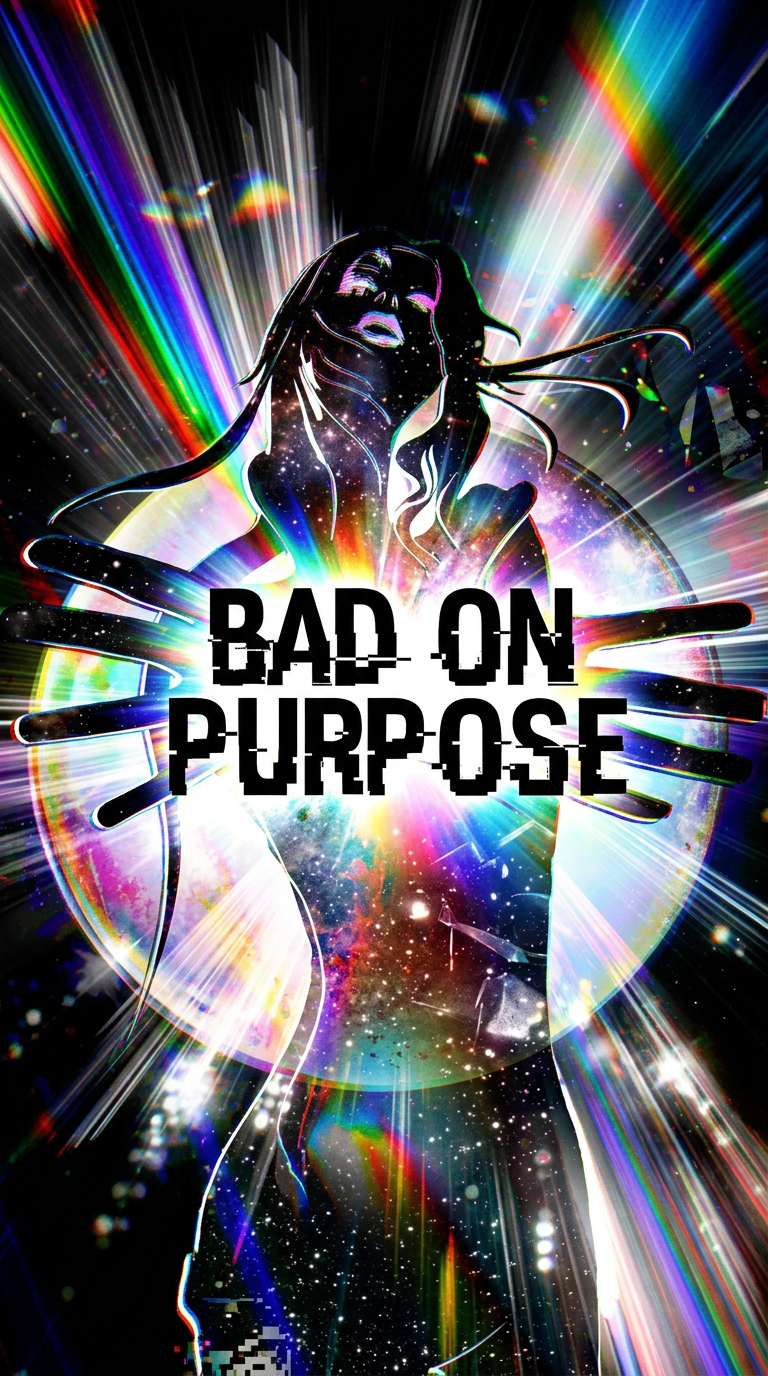
BAD ON PURPOSE
“BAD ON PURPOSE”
so powerful when
seen as a philosophical refusal.
Not refusal of care.
Not refusal of craft.
Refusal of sterilization.
A refusal to compress living reality into optimized presentation.
Underneath it, there are multiple mechanisms moving at once.
🌌 1. Anti-Perfection as Nervous System Liberation
Perfection culture often creates chronic self-surveillance.
The person is no longer:
expressing
exploring
participating
They are managing perception.
The nervous system becomes occupied by:
anticipation of judgment
image maintenance
optimization loops
self-correction
audience simulation
“BAD ON PURPOSE” interrupts this loop.
It introduces:
asymmetry
looseness
visible process
incompletion
human signal noise
The psyche receives a message:
I do not need to become machine-like to deserve existence.
That is not laziness.
That is decompression.
It restores permission for aliveness.
This connects deeply to the IN U orientation toward:
coherence over control
resonance over performance
living understanding over fixed polish
🌙 2. Visible Humanity Creates Relational Trust
Perfect surfaces often create distance.
They can feel:
untouchable
corporate
optimized
emotionally airbrushed
non-participatory
Humans unconsciously search for:
texture
friction
irregularity
breath
timing variation
imperfection signatures
Why?
Because imperfection is evidence of presence.
A shaky line.
A strange pause.
An awkward sentence.
A rough edge.
An unpolished photo.
These function almost like fingerprints of embodiment.
The nervous system recognizes:
a real consciousness was here.
This is why handmade things often feel emotionally warmer than frictionless production.
Not because they are “better.”
Because they contain trace evidence of life.
🌌 3. Resistance to Optimization Culture
Optimization culture quietly trains people to become:
infinitely editable
marketable
consumable
efficient
aesthetically compliant
The self becomes a product interface.
But souls are not interfaces.
Real life contains:
contradiction
weirdness
slowness
ambiguity
emotional weather
unfinished evolution
“BAD ON PURPOSE” resists the collapse of human existence into branding logic.
It says:
I would rather remain alive than become perfectly consumable.
This creates philosophical gravity because it touches a collective exhaustion.
Many people are starving for:
reality without packaging
expression without algorithmic polishing
sincerity without strategic positioning
Not polished authenticity.
Actual humanity.
🌙 4. Emotional Texture vs Sterile Coherence
There are two kinds of coherence.
Mechanical coherence
Everything is clean.
Consistent.
Optimized.
Predictable.
Controlled.
Living coherence
Something breathes through it.
Living coherence allows:
asymmetry
imperfection
emotional fluctuation
mystery
spontaneity
residue of process
A forest is coherent.
But not symmetrical.
Ocean waves are coherent.
But not identical.
Human emotional truth behaves more like weather than geometry.
“BAD ON PURPOSE” often preserves emotional texture that over-editing destroys.
Because excessive polish can remove:
tension
vulnerability
immediacy
intimacy
surprise
symbolic density
Sometimes polish improves clarity.
Sometimes polish removes the soul signal.
🌌 5. Authenticity vs Performance
Performance asks:
How will this be perceived?
Authenticity asks:
Is this actually connected to lived reality?
These are not always opposites.
But optimization culture often collapses authenticity into performance simulation.
Eventually:
vulnerability becomes aesthetic
spontaneity becomes branding
imperfection becomes curated
“rawness” becomes stylized strategy
And people can feel the difference.
Real authenticity carries unpredictability.
It contains:
risk
awkwardness
unevenness
unresolved humanity
“BAD ON PURPOSE” can become a way of protecting expression from over-curation.
Not because badness itself is sacred.
But because over-management can sever expression from direct aliveness.
🌙 6. Individuality Requires Irregularity
Mass optimization trends toward sameness.
The more systems optimize:
engagement
aesthetics
marketability
efficiency
virality
…the more expression converges.
But individuality emerges through deviation.
Through strange timing.
Unexpected combinations.
Unresolved aesthetics.
Personal symbolic language.
Emotional specificity.
The soul does not move in templates.
It moves in signatures.
Imperfection often protects signature integrity.
🌌 7. Soul Texture
“Soul texture” is difficult to define precisely because it is experiential.
But people recognize it immediately.
It is the feeling that something contains:
depth beyond presentation
lived experience
emotional reality
existential residue
inwardness
presence
Soul texture often survives in:
rough demos
old recordings
handwritten notes
imperfect films
cracked voices
unfinished sketches
strange experiments
Why?
Because excessive refinement can sometimes erase the evidence of becoming.
And becoming is part of the beauty.
A thing that still carries its evolution often feels more alive.
🌙 8. Imperfection as Evidence of Life
Perfect systems repeat.
Living systems vary.
Tiny irregularities are signs of:
emergence
adaptation
participation
embodiment
entropy
creativity
Even biologically:
heartbeat variation is healthier than rigid uniformity.
Too much rigidity in living systems often signals brittleness.
Imperfection is not merely tolerated by life.
Variation is part of how life functions.
So psychologically, visible imperfection can communicate:
this has not been disconnected from reality.
🌌 9. Foundational Philosophical Gravity
This becomes philosophically heavy because beneath “BAD ON PURPOSE” is a deeper existential question:
Must I become optimized to be worthy of being seen?
And another:
What is lost when humans reshape themselves entirely around perception systems?
The movement carries gravity because people increasingly sense:
exhaustion from performative existence
alienation from polished identity
emotional numbness from over-curation
loss of intimacy in optimized culture
So “BAD ON PURPOSE” becomes:
resistance
grounding
rehumanization
symbolic rebellion
nervous system reclamation
existential texture restoration
Not anti-beauty.
Anti-deadness.
🌙 The deeper paradox
The goal is not:
forced imperfection
aestheticized failure
performative anti-performance
Because that becomes another optimization identity.
The deeper movement is closer to:
allowing reality to remain alive inside expression.
Not sterilizing the signal.
Not removing every trace of humanity.
Leaving enough openness for presence to breathe through the form.
And strangely…
that often creates the kind of gravity people remember longest.
Because something inside them recognizes: